
Efficiency
so they say

Modern people are largely of the opinion that we use high speed technology, from cars to tractors to computers and AI, because we gain efficiency from it.
We toss the word efficiency around as though there were such a thing as efficiency, generic term, obviously a good, which has no referent. “It’s more efficient.”
In fact, efficiency only exists relative to some measure.
The dictionary isn’t a great help here.
ef·fi·cien·cy
/əˈfiSHən(t)sē/
noun
noun: efficiency
the state or quality of being efficient.
“greater energy efficiency”
an action designed to achieve efficiency.
plural noun: efficiencies
“to increase efficiencies and improve earnings”
technical
the ratio of the useful work performed by a machine or in a process to the total energy expended or heat taken in.
“the boiler has an efficiency of 45 percent”
Although in the above definition they do show the need for a referent: “greater energy efficiency.” Energy is the referent in this sentence.
All right, we’ll back up. Define “efficient” for me.
ef·fi·cient
/əˈfiSHənt/
adjective
adjective: efficient
(especially of a system or machine) achieving maximum productivity with minimum wasted effort or expense.
“fluorescent lamps are efficient at converting electricity into light”
(of a person) working in a well-organized and competent way.
“an efficient administrator”
preventing the wasteful use of a particular resource.
suffix: -efficient
“an energy-efficient heating system”
Achieving maximum productivity with a minimum of wasted effort or expense.
That’s not how we use it either.
When modern technological society says “efficient” it means, “Maximum output per person hour.”
We can waste a hundred thousand joules to save fifteen minutes of human labor and unabashedly call that efficient.
Then if we reduce the energy waste to fifty thousand joules to save fifteen human minutes we refer to that as “energy efficient.”
There are well over 8 billion humans on Earth. In the current high tech economy millions of people in prime working age and health are useless, because we do their work with machines powered with concentrated energy, well over 80% of which is derived from burning coal, naturally occurring methane, or petroleum.
Our ecosystem is dying from the outputs of this process.
“…with minimum wasted effort or expense.” Our definition of efficiency assumes, as a minimum, that the global ecosystem has no value. Therefore whatever ecological degradation our processes require does not get calculated as “expense.”
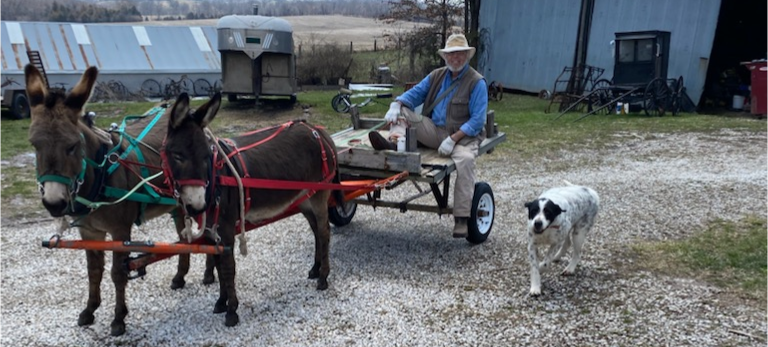
On our farm, we seek energy efficiency as a high priority.
There are some jobs where we on Slow Walk Slopes do rate time efficiency more highly. For instance, if our water system sustains a failure in winter and we’re going to be out in zero F temperatures working, we will expend energy to save time. But we don’t kid ourselves that this makes us more “efficient.” It just keeps us from freezing out in the miserable Missouri winter for any longer than necessary.
By our standards, any job we can do with our strength or the strength of our donkeys, mules, or horses is more efficient than that same job done with a fuel burning machine.
There is no power source known to humankind, aside from our own strength, which is more efficient than our donkeys. Donkeys can do more joules of work per joule of input energy than any machine or any other animal. Adding to that, the input energy which donkeys require is less concentrated than the input energy required by horses or mules, and the hours of work output from low grade forage is higher in donkeys than in oxen, which have to ruminate.
The fuel powered machines we do use are, relatively speaking, small scale, low speed machines. In all cases, increasing speed arithmetically requires increasing energy inputs exponentially. To double speed requires four times the energy.
As one concrete example, a typical statement might be, “The county road district bought a bigger tractor. Now we can maintain the roadsides more efficiently than we could before.”
To translate that into English, “Now we can spend four times as much diesel fuel to mow the roadsides twice as fast. Our only referent is how many operators we pay and for how many hours, so this is more efficient.”
If the governments of the United States cared about ecosystem degradation, climate change, mining, manufacturing, or waste, they could park all the tractors forever and hire the county’s unemployable, poorly educated work force, most of whom now make their livings via theft and petty crime, and pay them to mow and trim the roadsides.
In terms of maintaining a livable ecosystem for the current and future generations of humans this would be vastly more efficient.
Right now today there is no resource available to the human race at larger quantities for lower ecological cost than human labor. The only reason that “efficiency” came to mean “less human labor” was because the word was captured by the owner class in a capitalist system.
In terms of living creatures and Earth our home, it’s exactly backwards.
I find my own hands way more efficient in all ways in milking the cow over the machine I used to use to save time. I cherish the time milking, and my cow prefers my company to the machine any day. Way less to wash as well, so water is used efficiently.
I respect and find hope in your words, thank you.
One thing I don't see people talk about a lot is whether it's realistic to go back to animal-based forms of power with our current population and density-levels. Is this something we could or should have done but it's too late now too realistically pull it off? I can't really imagine a pathway to it but if you can I'd love to hear it.