
Feeling good
All the money in the world spent on feelin' good

I fought in a war once, and I’m going to tell you a war story.
Don’t be worried. There is no blood, no guts, no death. There are no heroes or bad guys.
I fought for a year as a light weapons infantryman, my rank ranging from private to sergeant, in The United States’s war in Vietnam. I didn’t want to go, but I was drafted at the age of 19, and from where I was on that day, of the choices available to me after that draft notice came, going to the Army seemed the best of a bad lot.
It offends me to be thanked for my service. That’s a whole different essay, just information to anyone who might be interested in it.
I was assigned to a unit of the 4th Infantry Division, located in Vietnam’s Central Highlands, an old, worn down mountain range covered with an ancient rain forest. In the way that war was fought, infantrymen went out to the jungle with a company, usually somewhere in the neighborhood of 100 young men between the ages of 19 and about 25 at the oldest, with a handful of 40-ish professional combat soldier sergeants to do the real leading, and a smaller handful of 20 to 30-ish year old commissioned officers officially in charge.
We went out into the jungle and we stayed there, for weeks and months at a time. The image of infantry combat from the desert wars fought by the generations after mine is of people, men and women, living in barracks buildings, pretty sparse but still beds under roofs, and going out from time to time to engage the enemy. In camp you might expect email, maybe a cell phone, regular contact with The World. That’s not how it worked in Vietnam in the 1960s.
We went out into the jungle and we stayed there. Every morning we would get up, tear down the tent we had slept in and divide it among two or three men. We would empty the dirt out of ten or twelve sandbags per man, roll them up, and put them onto our rucksack. We would put the dirt and logs we’d sheltered behind the night before into the foxhole we’d dug so nobody could use it after us, we formed into two or three columns of men, and we walked through the jungle for four or five hours, navigating by maps and compasses which every man carried. Each day we moved to a destination chosen by someone with a clean uniform who’d spent the night indoors.
Each of us carried a rucksack containing up to 3 days of canned food, called C rations. Later in my year there we started getting freeze dried rations which were better, but not enough to fully replace the Charlie rats. Each man carried about five quarts of water in plastic canteens. Most men carried fifteen or twenty or so magazines for their M-16s, but a few - typically four in an infantry company, one per platoon - carried a machine gun each. Each and every enlisted man carried a hundred rounds of machine gun ammo. Most of us carried a hand grenade or two, maybe more. We carried one or two ponchos, which we never wore to keep us dry. Ponchos were our houses. Two ponchos snap together to make a two to three man tent. Another poncho goes across the windward end to keep the rain out while we’re sleeping, and one more makes a ground cloth to sleep on.
Each of us carried a thin nylon quilt called a poncho liner, which was our bedding. We were issued air mattresses, but they weren’t very reliable, and when you’re carrying your life on your back, weight matters more than comfort. So most of us slept on the ground, separated from it by only an army poncho, covered with a poncho liner. Often as not a steel helmet supported our heads as our pillow.
Each man carried a machete and an entrenching tool (folding shovel).
Besides that men carried books to read, letters from home, and writing materials to write home. Every 3 days helicopters would come to wherever we were, deliver us the next three days of meals, and mail from home. Typically a letter from the US got to Vietnam about seven weeks after mailing.
Freshly resupplied with food, fully stocked with ammunition, and with all our canteens full, each man carried somewhere between 70 and 90 pounds on his back, walking up and down mountain slopes, all day.
After we did our day’s “hump” and arrived at our location for the night, we had to set up camp. The hundred men would get in a circle where each two or three man group had enough room to set up a hootch and dig a foxhole. That was our perimeter. After that initial organization, we would cut down every tree within a hundred meters of our perimeter, all the way around. That was called a field of fire, and was bare so opposing troops couldn’t sneak up through the woods on us.
We cut those trees with machetes. Corn knives, No chain saws - we’d have had to carry them, and carry the gasoline. No hand saws, same problem. Machetes. We kept them sharp.
We would also dig a foxhole for every two or three man hootch group. You know those little folding shovels they sell at camping stores, with the screw collar to keep the blade extended? The ones that don’t quite reach to your hip? The little shovels that sort of look like a toy?
In Army talk those toy shovels are called entrenching tools. Those are what we dug our foxholes with. In mountain soil. Every night. We took the dirt out of the foxhole and put it in sandbags, so a foxhole only had to be half as deep as we were tall. A sandbag wall would make up the difference.
We cooked our meals in the cans they came in. If we were lucky we had little lumps of fuel called heat tabs, which burned at an appropriate heat and rate to heat up a can of beans, or potted meat, or any other of the ever so appetizing available entrees.
If we weren’t lucky, and supply didn’t have any heat tabs, we tore up C4 plastic explosive blocks and burned little lumps of high explosive about the size of a lima bean. It has to be detonated to explode, but can easily be burned. It burns way too hot for cooking and tends to spoil the meal. If you’re hungry enough you eat it anyway.
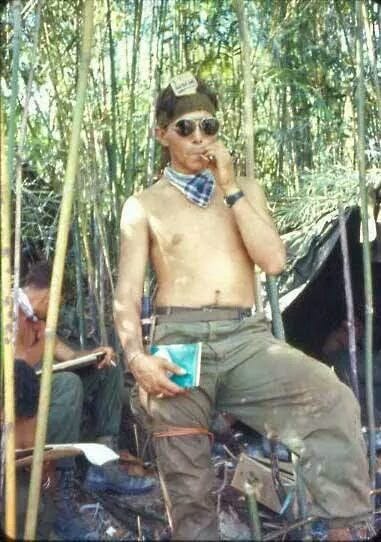
We wore the clothes on our back until the powers that be delivered clean ones, which was typically about once a month. It was not possible to wear underwear because of rash and fungus issues. The red-brown discoloration on my pants in the photo above is red clay mountain dirt. I might wear them another couple or three weeks like that.
The shovel that dug our foxholes was also our bathroom facility. To defecate, a man took his shovel, a small roll of toilet paper that came with the C rations, went a little way outside the perimeter but still well within the field of fire. dug a hole, squatted over it, filled it, covered it over, and went back to work.
what I have described was a regular day for me, and for all the people around me, for a year of my life. In my outfit, out of every 100 men assigned, 88 would be hospitalized either because of wounds or sickness within his year there. I was hospitalized for both during my year there.
I arrived in Vietnam three days after my 20th birthday, and arrived home on my 21st.
The most important thing I learned in Vietnam was that a good day or a bad day has little to do with your surroundings, little to do with your standard of living. A day when nobody shoots at you, when you get a letter from home, those are good days. A day when the black flies bite you while you’re clearing a field of fire, a day when everybody you can see has streamers of blood running down his back from fly bites, that has a good chance to be a bad day. It’s always a bad day if they shoot at you.
This is the most important thing I ever learned. I, or any of the other hundred men around me, might be halfway around the world from home, wearing filthy clothing, no underwear, eating barely edible crap out of a can we only partly opened, so we could fold the lid into a pan handle to cook and eat. Always, running parallel to everything else, was the knowledge that at any moment somebody might launch a mortar bomb at us or run up shooting at us. In spite of all that, we could still have good days. Lots of good days.
There were no bills. There were no traffic jams. There were no decisions. Get up, work, walk, work, eat, sit with friends and talk of home, of loved ones, of dreams, and it could be as good a day as any other day anywhere ever. A good day is a good day.
When I write of living a simpler life, of living without TVs and computers, without cars and bars, living a quiet life in a small home with people you love, I’m not talking about sacrifice. I’m talking about, all the crap we’re killing the world with and for doesn’t make us any happier than I’ve personally been, just knowing that my foxhole was dug and I didn’t have to dig another one until tomorrow.
The ancient forest spoke to us all night every night. More often than you might think, a tired old standing dead tree might fall in the night, a cascading, crashing, fading sound. On the way out of our campsite in the morning we might find a tree across the trail that was so broad that, laying down, we couldn’t easily climb over it, and would have to make a trail around it.
We got our water from clear mountain streams. I grew up in Missouri, in an allegedly civilized, advanced nation, and we couldn’t drink the water out of our streams. Here in this jungle we could.
Although we did find our later that our side had sprayed Agent Orange into at least some of them, upstream from our campsite, leaving us filling our canteens with poison. The natives hadn’t done it.
Everything that salesmen and PhDs tell you about the absolute requirement of Progress and a High Standard of Living in order to live a happy life, every word of it, I have lived the rebuttal.
There is nothing about modern technological life which enhances our chances of having a good day on any given day. I fall for it just the same as others, but it’s bullshit. The toys don’t make us happy. Friends make us happy. Peace among nature makes us happy. A decent meal when we’re hungry makes us happy. The entire developed world could start to walk away from modernism today, could progress to where nothing man-made travels any faster than a running horse or a clipper at full sail, and be no less happy, day by day, than we are now.
Personally I think we’d be happier. We live in a culture where despair takes more lives than disease, where anger kills and depression empties lives out. We’ve got more stuff, and go faster, than anyone before us in all of geological history, we’re killing the entire ecosystem to do it, and we’re, overall, not happy.
We can do better.
Thank you for your story.
I don't know how many will understand. Of those that understand, I don't know how many will be able to change.
Lies have dominated our world for so long, the learning curve of the truth is fairly steep.
It's a life or death situation, whether people see it now or later can make a difference.
I hope you and yours are doing well.
Thanks so much for this. Powerful testimony, and conclusions won the right way. Take care.