

Presumably everyone able to read already knows about the blockage behind which wait one fifth of the fuel, and one third of the fertilizer, used by industrial society worldwide.
Presumably everybody knows that without the Haber-Bosch process of producing biologically available nitrogen, industrially farmed land can barely even produce weeds, let alone crops.
Everyone should know, but I’m not sure how many do, that the endless flow of edible plant and/or animal parts is necessary every single day to maintain human nutrition, and that without it, no human can live very long.
I can’t speak to agriculture worldwide, but I can speak of agriculture in the United States. The first, and most important, fact about it is that well under half of it directly produces food for humans.
Total cropland in the United States in 2024 was 328 million acres. Over half of that cropland was used to produce exactly two crops, field corn and soybeans. Neither of these crops is produced primarily as food for humans.
Approximately 6% to 7% of global soybean production is eaten by humans annually. In the United States, less than 2% of field corn, our largest single crop, is eaten by humans annually.
If we add in cooking oil and the barely edible high fructose corn syrup, human consumption of both crops edges up into the double digits, but just barely. Field corn and soybeans aren’t grown as food, they are, like petroleum, predominantly produced as industrial raw materials.
A fair percentage of both corn and soybeans is fed to animals which will later be eaten by humans, but if we were concerned about sudden industrial shortages causing starvation worldwide, wasting grain to produce meat and eggs would not even be under consideration. Cattle can live on grass. Hogs can live on forage and garbage. Chickens can live on bugs, weed seeds, and garbage. Humans can live on plants and don’t really need much if any meat anyway.
Second only to livestock production, roughly 40% of all field corn grown in the United States is converted to ethanol for use as motor fuel. It is claimed that roughly 1.5 to 2 more units of energy can be obtained from ethanol than goes into its production, but at a time when nitrogen fertilizer availability is limited I think it is fair to ask whether it is more important for humans to drive than it is for them to eat, and I think the answer is no.
The largest two inputs into a bushel of corn are diesel fuel and fixed nitrogen. These are the same two inputs which are limited as a result of the US/Israel attack on Iran. Soybeans, as a legume, are able to fix nitrogen through symbiotic bacteria and do not require Haber-Bosch nitrogen, although some agronomists still recommend nitrogen applications, particularly in irrigated, high yield systems. Nitrogen notwithstanding, industrial soybean agriculture is still primarily a method for converting diesel fuel, topsoil, and (often) groundwater into other industrial raw materials.
54% of US cropland is used to produce predominantly non-food crops. This fact is totally ignored in virtually all discussions of agricultural energy requirements and human food insecurity. That cropland is managed in ways which virtually guarantee that virtually no wildlife, no birds, no insects, no fish, and even very few microbes can live on it. It is compacted by huge tractors, cultivated, sprayed, planted and harvested with diesel fuel. It is subsidized with public funds. It employs very few people. John Deere is producing autonomous tractors, combines, and spray vehicles to eliminate the few jobs which remain.
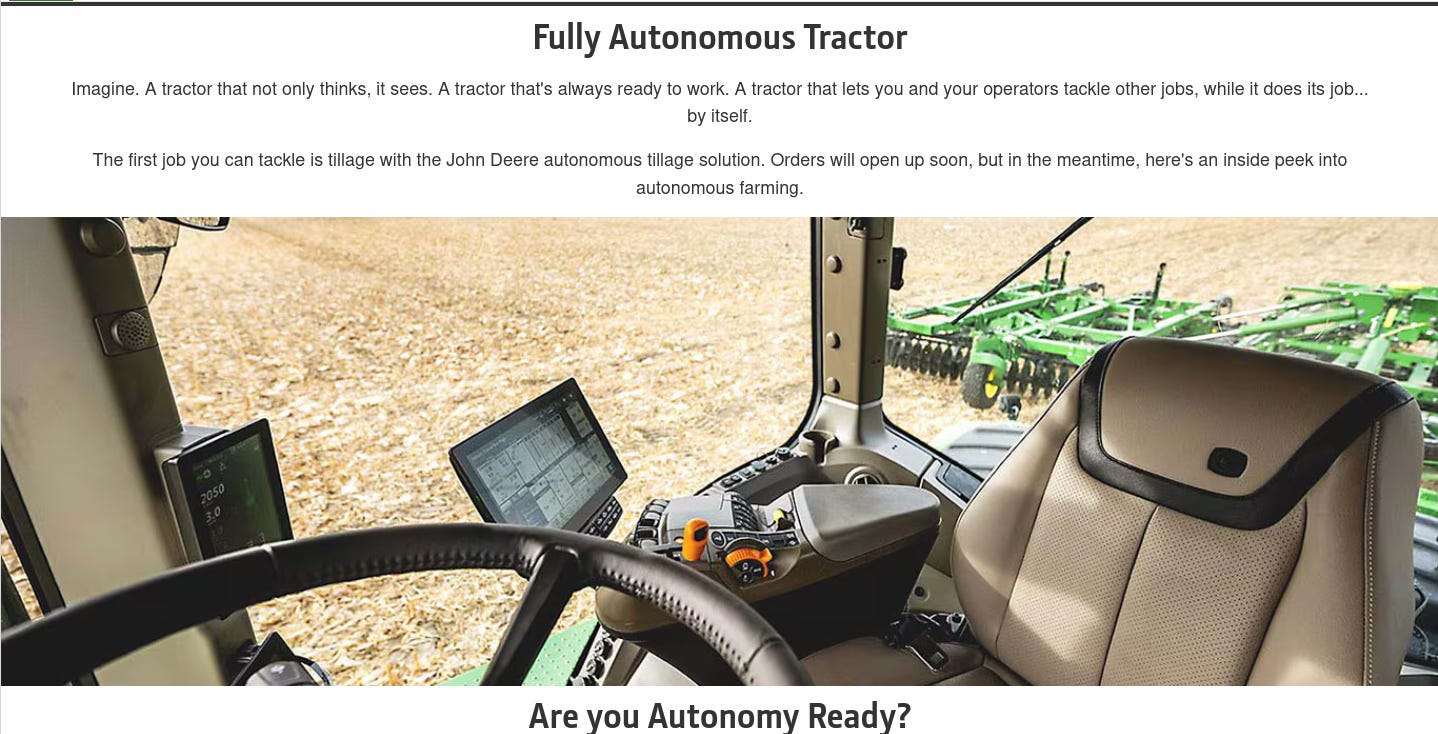
Meanwhile, any discussion of reducing the energy wasted on this industry is met with cries of Starvation!
I doubt if the shortage of diesel fuel and Haber-Bosch nitrogen resulting from the current war will result in any re-allocation of either fuel or fertilizer to food production. I expect to see global hunger and perhaps starvation while we continue to waste these finite resources on purely economic industrial agriculture. I expect to see self-identified climate concerned people continue to praise biofuels and bioplastics.
I can’t make any of this stop, but I refuse to pretend it has any purpose other than to further enrich the already wealthy.
So, we convert petroleum diesel to biodiesel at a net loss of topsoil.
Sounds like a great deal, if you're on the side that makes the profit both ways.
An industrial farmer, on the other hand, sells at wholesale, buys at retail, and pays the freight both ways.
The image of the JD autonomous tractor towing the disk seeder gave me a laugh. I can tell you all now that the tractor has no ability to stop every hour. Unblock seeder hoses, and scrapers, feel for hot wheel bearings, feel for play in control arms etc plus the myriad of other common failures. Just another techno optimist dream of replacing humans that will never actually work but I digress.
Cheeers