
Technology v. 2.0
another attempt at explaining my viewpoint

Everybody wants to talk about technology. I want to talk about energy.
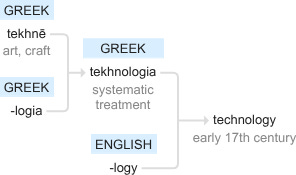
I searched Google for “technology definition” and this was the first reply:
“noun
noun: technology; plural noun: technologies
the application of scientific knowledge for practical purposes, especially in industry.
“advances in computer technology”
machinery and equipment developed from the application of scientific knowledge.
“it will reduce the industry’s ability to spend money on new technology”
the branch of knowledge dealing with engineering or applied sciences.
The derivation diagram shows us a word which has been in use since the 17th century, since the early years of the Enlightenment. Technology is clearly a word of the Enlightenment, the era when today’s overweening, ecosystem destroying, technological hubris was born.
In spite of that history, to many if not most people in the English speaking world today technology has come to mean “computer stuff.” Over the years I would say a majority of my conversations online about technology are reasonably well represented by the following reply I recently received:
In my own brain I divide things into technology and tools where technology requires some kind of concentrated fuel or electricity and tools are muscle or powered by residual flows of energy like mechanical wind or solar thermal. I feel like technology was a bad gambit but we turned it into a quasi-religion so only a tiny minority is able to have a reflective honest conversation about it. Utilitarian materialism is essentially the religion of the day so we have to assume new technology is going to be good and we should devote all our resources into new technology because everyone is forced to play a stupid game that makes everyone miserable. I guess I’m just trying to say a human who uses what’s between their ears and some elbow grease with the right tools is able to achieve everything they need and then some and that’s never been in doubt.
I use the word “technology” to mean definition 1 above. Applying (scientific) knowledge to accomplish things.
The machine pictured below is called a “post drill.” It was a blacksmith’s tool. I have recently restored it to full usability. This tool does the same thing as a modern drill press: It drill holes exactly perpendicular to surfaces and exactly straight through objects. This one runs on food energy. The drill press runs on concentrated energy, usually in the form of electricity, which is primarily the output of a lossy conversion from fossil fuels.
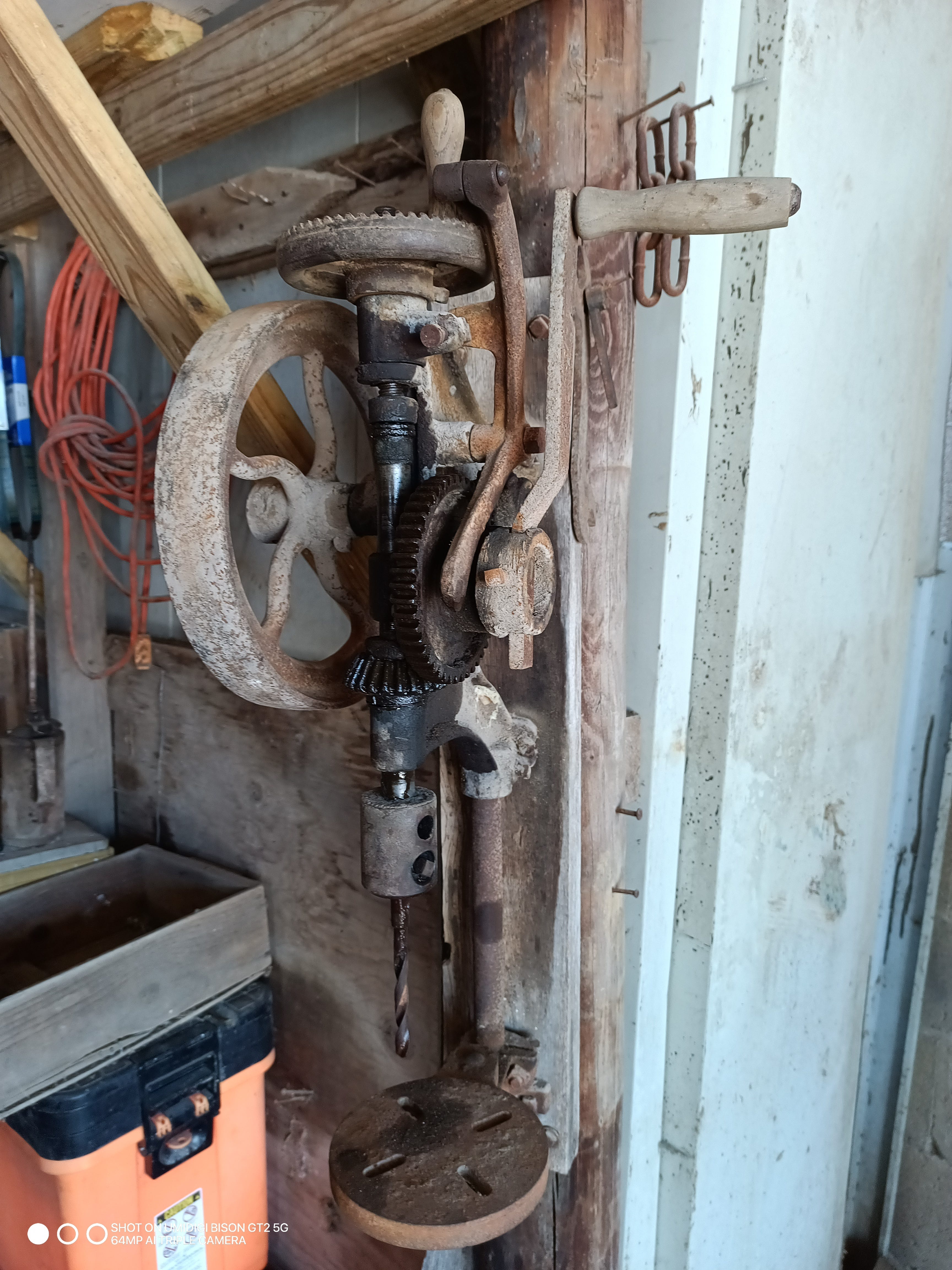
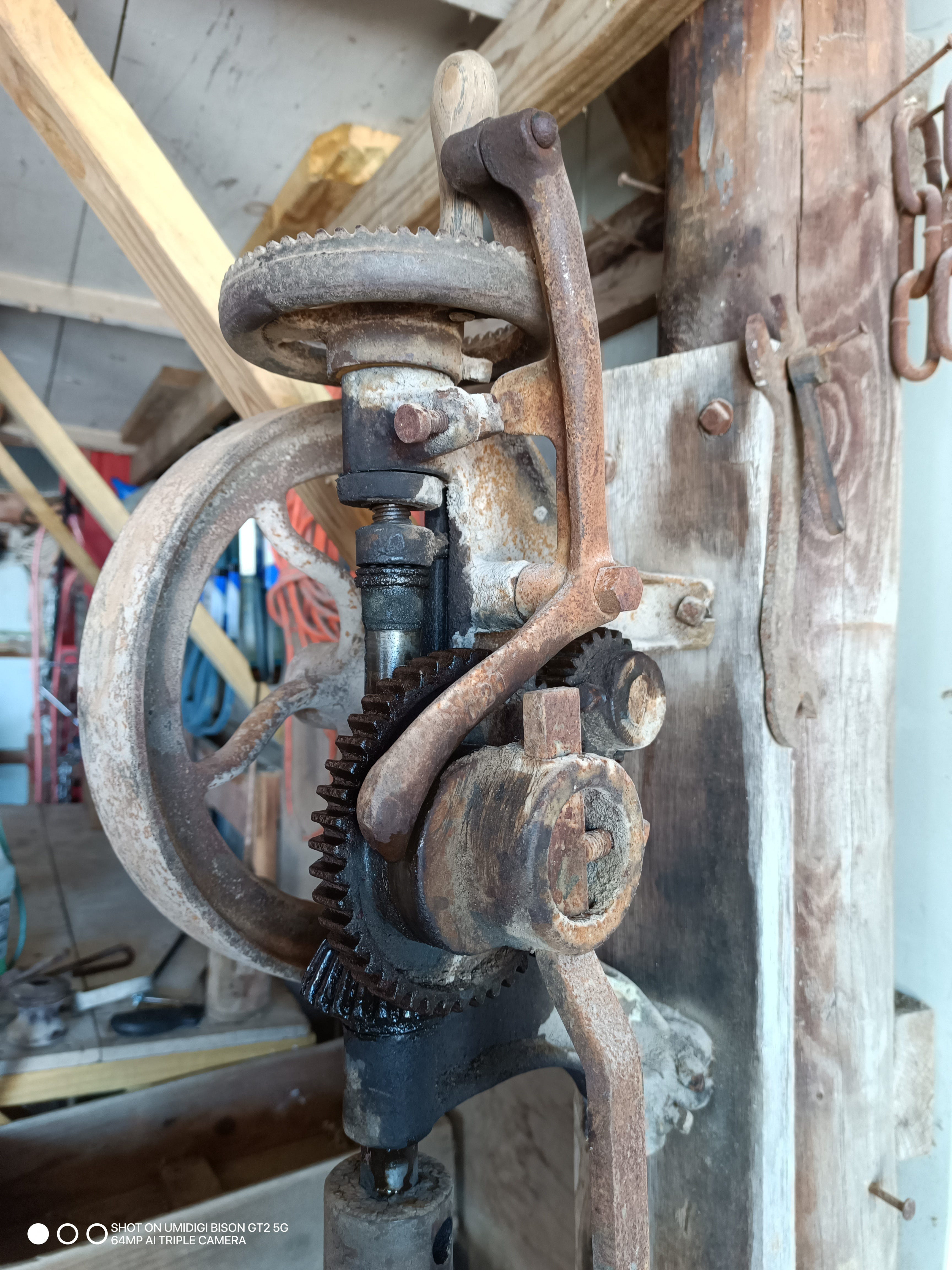
This tool is very definitely the application of scientific knowledge for practical purposes, especially in industry. By application of scientific knowledge of leverage, power transmission, gear ratios, cams, and other principles it enables one man, with no energy besides his body’s normal throughput (assuming his norm is to do something) to drill precise holes in steel and other metal objects quite easily. Besides drilling the hole the technology also provides downward pressure on the workpiece through the cam, lever, and ratchet visible in this image.
During the era before widespread electricity, analogs to most of the electric hand tools we use today were already available. They had lathes, drill presses, bandsaws, scroll saws. At that time one school of designers / inventors of technology assumed a given input force and designed to magnify the outputs of that force. No added energy. One horse, two horses, one man, two men - the amount of work the energy sources could put into a task was not that variable. Technologists developed more and more elegant ways of taking the energy available, the human and helper, the team of horses, sometimes a four up or more, but - the last year you could buy a brand new horsedrawn hay mower in the United States was 1952, The McCormick No. 9, and those mowers are still in use today on Amish farms across the entire eastern United States.
There are also Amish manufacturers making new ones today. I dream of building one I can pull with a team of donkeys, but they won’t mow five feet, Probably three, maybe even four. Lower energy output but much lower input. I’m not in a hurry, not any more. The rat race is over. The rats won.
By the end of the horsedrawn era you could take a team of horses and drive them across your field reaping your crop and binding it in shocks for further handling. By today it would be entirely realistic to take a team or maybe three up and do the whole harvest, reap, thresh, winnow, bag. There are combine harvesters in Asia that could easily be pulled by two or three horses with a ground drive input and work as well as they do on diesel.
There are entire generations of technology which took the energy available in humans and animals - literally 100% food energy - and gave it the ability to do more work, better work, for no more hassle and usually less. Technology magnified energy.
Then the heat engine was invented and put into use. The rules of the game changed overnight. The old technology gave humans new powers. The new technology gave a few humans new powers, and made ten or a hundred or a thousand times that many powerless and economically useless. The new technology wasn’t limited in energy input.
Virtually overnight the thrust in technology turned away from making machines which could do ever more with our food energy, to making machines that replaced food energy with concentrated energy. Suddenly the thrust was, how can I find a way to put more fire energy into more processes and get faster outputs?
When most people think of technology today whatever they have in mind has one underlying common characteristic: Technology is that which enables us to apply fossil energy to some objective.
In order to speed the result, you increase the energy throughput.
What is the difference between Microsoft Basic on an 8080 and AI? AI is the result of 45 years of adding energy throughput to processing.
It takes one nibble of energy to activate one transistor. It takes one chomp of energy to activate a modern laptop processor full of transistors, even though they’re really tiny.
It takes one eat-an-elephant of energy to run one Google AI search.
That’s it. Run more energy through. Suck up all the fresh water that we’re already running out of to spread the entropy, which shows its pretty face as heat, throughout the atmosphere.
A few years ago I attended a virtual Perennial Farm Gathering at the Savanna Institute. Over the three day event virtually every presenter spoke of ways to mechanize their crops and increase their efficiency.
On the third afternoon, in a group chat via Zoom, I pointed out that in every presentation I’d seen the one recurrent objective was to add energy inputs into their system. One woman got it and was taken aback.
A few years later they had one where the stated objective was reducing carbon in farming operations. I offered to do them a presentation on animal agroforestry with donkeys and they couldn’t be bothered to say no.
The additional energy input their presenters were seeking would not increase the energy output. It would accelerate processes, which theoretically would then give them time to plant more and so forth. Harvest could be done by fewer people faster.
There are eight billion plus several hundred million people on Earth.
It would be impossible to figure out a lower rational priority for human technology than to employ fewer of us to feed ourselves. On any given night in America between three quarters of, and a million people, don’t have a roof to sleep under. They are economically useless in America.
These people are going to eat or starve. I’d say if the choice is between a human and a diesel tractor, I’d rather let the tractor starve. Even if all the tractor ate was sunflower seed oil, I’d let it starve. The energy of that sunflower seed oil could go into some living thing. It’s not like we’re overpopulated with songbirds or whatever.
What we think of as technology is nothing more or less than energy extracted from the natural world and applied to things we want to do.
To be fully qualified as technology it has to run on concentrated energy. Anything except food.
When I drive my donkey team into town I do not expend any energy that did not go in through their mouths. The primary exhausts are a solid and a liquid, each of which contain important fertilizing elements. We currently harvest the solid and spread it on the land, usually using food power (the same donkeys) to spread it over the land.
It would be a technological coup for me to be able to harvest their idle time urine for the land, but it’s not likely something I’ll get to.
Nate Hagens recently wrote an essay about technology which he titled The Straw, The Siphon, and the Sieve. I think it’s a good essay, and Mr. Hagens has a well deserved good reputation, but I think it telling that at no point does he link energy to the processes he describes.
He has the straw and the bigger straw. Everybody knows if you get a bigger straw you have to suck harder. If you’re sucking with diesel you’ll burn more of it. Every technology scale increase Nate refers to was made possible by a relative increase in energy throughput.
The same applies everywhere I look. Everybody wants to talk about technology. I want to talk about energy.
With human powered and animal powered technology, one hand tool or horsedrawn implement easily be expected to last 100 years or more. I’ll be mowing hay on my farm this summer with a 125 year old John Deere hay mower. With that mower and two horses I can mow a five foot wide swath of hay at every pass.
I can’t do it with my donkeys, but we’ve got draft horses and draft mules in our community.
I have a diesel tractor that’ll do it too. Five feet at a swath. It’s claimed to have 23 horsepower.
Hay burns hotter than diesel fuel I guess.
If technology lasted a hundred years we wouldn’t have to mine much. I personally own several, hundred year old tools. Most of my best tools, in fact, are a hundred years old.
What tears up modern tools is excess energy. Adding energy adds stress in every direction on every moving part. Speed is another word for energy. The faster we go the more we break.
The two types of technology appear similar, but in fact they are opposites.
Appropriate technology allows us to do more work without increasing energy inputs.
Destructive technology replaces skill and living energy with concentrated energy, primarily fossil sourced.
We need technology. As humans, we have always done technology. We took the wrong path when we imported energy to replace life.
Post drill. Thank you for that term. I inherited one from my wife's late grandfather that I still need to restore, but I only knew to call it a "manual drill press."
I've found that shopping for tools at antique shops, with the intention of applying elbow grease back home, is a pretty good way of getting extremely durable items. They aren't shiny (yet, haha!), but they're often cheaper than the shiny new thing that will require either a wall outlet or a battery pack.
Three things:
1. Brilliant, as you often are. :-)
2. Nate’s entire MO is to make us less energy blind as a society; further exploration of his content is warranted.
3. Not sure it was the wrong path as much as the inevitable one once the monkeys found the flammable fossils.