
That's not it.
And other ridiculous responses

I spent my working life as a repairman of complex systems. More than anything else I repaired telephone systems, back in the days when they ran on copper cable.
The global telephone network is an almost indescribably complex system. Essentially a user can pick up any telephone on Earth, dial a bunch of numbers, and be connected to any other specific telephone on Earth almost immediately, exchange information by the spoken word for as long as they choose, and then disconnect, leaving all the components of their connection available for the next person to use.
Just as an example - this will only make sense to you if you are old enough to have lived in a world where dial tone was a regular feature - if you had a telephone in your house or business, you could pick up the handset and by the time you had lifted it to your ear there would already be a steady tone playing down the wires to your ear, a tone which told you the system was ready to accept your dialed digits.
When I went to school on that machine, the one that gave you dial tone and connected you to anyone you wanted to talk to, we started out with two books, a circuit description, a book which explained in words what was happening, and a circuit diagram, a larger book with drawings representing where all the electricity flowed and how it got switched to do what we wanted.
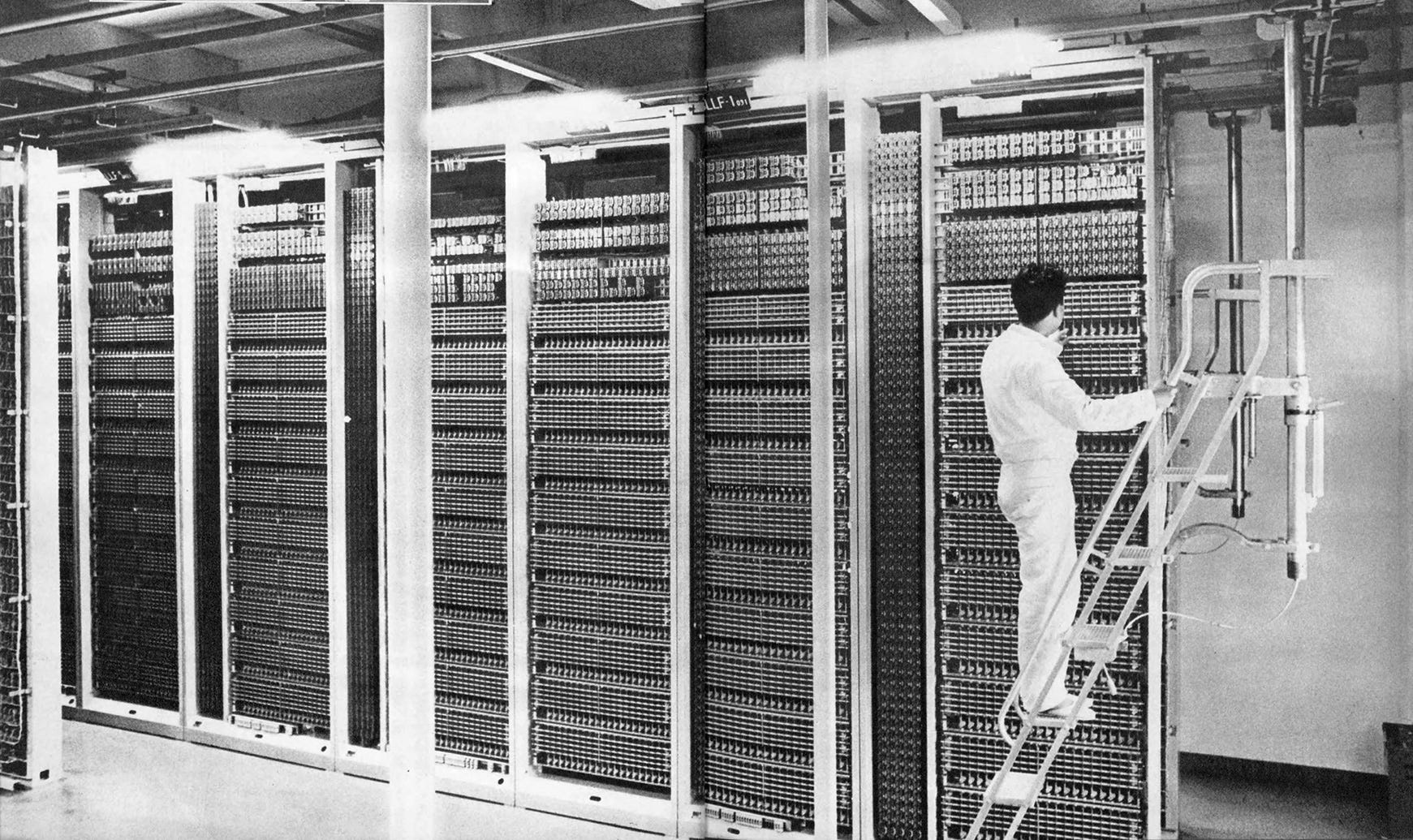
This school wasn’t like a college, where students move from class to class, studying subject A for an hour on Monday, Wednesday, and Friday, subject B on Tuesday and Thursday, and so forth. This school was 8 hours a day, five days a week, for thirteen weeks, studying one machine’s operation from start to finish.
On the first day of school, at about 8:05 in the morning, the class opened the circuit description and read the following sentence: “The subscriber lifts the handset.” Then it goes on, battery and ground through the windings of the L relay through the cable to the subscriber’s phone, through the hookswitch and network, operates the L relay. Step one of calling someone on a Number One Crossbar Central Office.
Two weeks later, at 3:30 or 4:00 on Friday afternoon, the student reads the following sentence: “Dial tone is heard,”
In the subscriber’s life, nothing much happened. Picked up handset, heard dial tone, called Bob. In real life, relays operated other relays which actuated decision networks to find paths from the phone to decoders, busy or defective circuits were eliminated from the choice network, more decisions were made, and this incredibly complex machine found a path to get ready to decode and store the digits to indicate the desired connection, and sent to the subscriber a signal that the machine was ready for this. So many relays had to operate, so many decision paths had to be solved, that just to read about it and trace the path on paper took intelligent people two full weeks of work.
Amusingly, people today believe that the old system was analog, didn’t have digital decision making functions, and required less knowledge than fixing a computer. This is exactly the opposite of the truth. In a computer you only troubleshoot to a whole board full of decision making chips and swap it out. Troubleshoot to a block diagram level. Before that you could troubleshoot to a component level. We troubleshot to a single function within a component. In a crossbar relay office, you troubleshot to one dirty relay contact and cleaned it, which is roughly like troubleshooting to the specific bad “transistor” inside the chip and repairing it. Only once in my life since the “digital” revolution did I ever work anywhere where we even troubleshot to the specific chip and replaced it, and that was just because my employer was too broke to buy whole circuit boards and he and I were both trained and able to troubleshoot to the chip level.
The last “analog” telephone system was before the invention of the rotary dial, back when you picked up the receiver, cranked the crank, and said, “Grace, get me Henry Jones.” Grace was analog. By the time rotary dials came along they were the very definition of digital, 1 and 0, on and off decision making. A rotary dial literally turned the circuit off and back on once per digit quantity, once for one, six times for six, and ten for zero. Digital digits. It ran on relays, turned them on an off, what someday would come to be called ones and zeros, all powered by a basement full of 12 volt lead-acid batteries connected to provide 48 volt DC power. The “originating marker,” a processor to find you dial tone and then later to connect you to your desired distant party, was about as capable as an 8008 digital processor, except an 8008 was smaller than your thumb and an originating marker was a steel box four feet wide, twelve feet tall, and a foot deep, a box full of relays that turned on an off, operated and released, and the programming was fixed and all wires.
As soon as you heard your dial tone the originating marker dropped off to be available for the next caller. Only after you had entered all your digits would another, or possibly the same, marker be summoned to process and form a path from your mouth to your friend’s ear. This is called “common equipment,” equipment shared among users, and is still a feature of miniaturized digital circuitry.
The office I worked in served 40,000 telephones in Johnson County, Kansas. It had 8 originating markers, which were able to serve all the calls placed by those 40,000 phones, at two uses per call. They were fast. They may have been giant boxes of relays, but they were fast processors. All it took to bring one down would be one dirty relay contact, and somebody wouldn’t get dial tone. When the switchman placed a test call the marker would go Ker-whonk! and be done. We would have to know what relays needed to operate to attain the objective, and place scraps of paper torn from a sheet in the armatures. After it went Ker-whonk! and all the scraps fluttered to the floor, the scrap still in one relay or group of relays told us what hadn’t operated, what path was defective. From there, with the same circuit description and circuit diagram books, we would troubleshoot to the dirty contact, clean it, and return the marker to service.
And that’s just to get users dial tone. And it’s just one function. The Central Office in those days was a large, two story building full of relays. It hummed, rattled, and clattered nonstop as people placed calls and ended calls. While they talked their path was still, maintained. The voice part was still analog, audio AC carried by 48 volt DC through the miles and miles of wires which made up that one central office.
When they hung up there would be a cascading clatter across the building as all the magnetic connections between them were dropped.
During the day it was an endless roar. At 3:00 in the morning, in a quiet suburb, there would be times of complete silence, as there was no activity among our whole 40,000 users. Then somebody would make a call. Ker-whonk! as they drew dial tone. Back then over half of the phones in Johnson County still had rotary dials, and you could tell by listening which kind of dial the caller had. If they had a rotary dial, after a few years in the business you could write down the number they dialed, just by counting clicks. With one of them new-fangled Touch Tone phones you just got one click per digit, as the system decoded and stored it. Somebody would make a call, the machine would clatter, and then silence. When they hung up you could hear it drop all the connections spread across the building.
It was a fascinating machine. One could work on it for years and never get bored. Unfortunately, it was owned and operated by a giant corporation, and after about five years I’d had all the fun I could stand, and I left.
By that time, businesses were able to own their own in-house telephone systems. This was before most living USians were born, so the odds are you don’t remember this. Those in-house systems were the same technology as central offices, enabling staff to call one another in-house as well as to dial outside to essentially any telephone in the world. My knowledge still had a market, but I had other things to learn. I had to learn people.
People are always the hard part.
People think they know more about everything than you do. I’d go into a business on a trouble call, troubleshoot the failure, possibly with the same “bits of paper” technology I had used in the CO, clean some dirty contact, test the problem clear, and go to get my ticket signed.
“What was it?”
I’d tell them. “Dirty relay contact in a trunk circuit.”
And then, about half the time, “Oh, that wasn’t it!”
Huh? It wasn’t working. You were here. I wasn’t. You couldn’t make it work so you called me. I came, and now it’s working. And you’re telling me I don’t know what I did to fix it? Why didn’t you fix it yourself?
As years went by I became the repairman of last resort. When nobody else can fix it, send Jeff. Jeff could fix it.
This is what writing about systems to use less energy to reduce ecosystem degradation and greenhouse gas emissions is like. I’m out here, an old geezer troubleshooting the system to the component level, saying, We’ve got to change the system, and here’s the component or feature which makes it able to operate as it does.
In the unlikely event that you’re interested, here’s how we could do it.
All these people who have never troubleshot a device, all these people with PhDs and strings of letters after their names, tell me I don’t know what I’m talking about. What we’ve got to do is make some new policy, build renoobles, degrow, reduce our population - I had a guy today tell me that burning less fuel, admitting less energy into our system in order to develop a lower energy system wouldn’t work, what we needed to do was reduce population and he had a system which would to it in 35 years…
35 years. What’s your rush?
It’s contact 2 make on the G relay. Clean that and…
Oh, never mind. I know. That’s not it.
Fix it your damn self. More likely don’t. I’m tired.
love your honesty. my dad worked w the telecom system w university in my hometown, early 70s and on. mainframes--and he cld think inside out about many things. musical and brilliant. so I am listening. keep writing and growing your edges, please. Can't wait to meet some mules and a wagon.
Worth reading twice ;)