
Whodunit
and who we blame

It is a widespread belief among climate concerned people that certain bad actors, a tiny minority of the peoples of developed societies, did specific actions which have created the climate and ecosystem catastrophe around us.
The following quote comes from an essay by a writer I follow and often agree with, but not this time.
I am not crediting the author of this essay because I plan to criticize it, and the belief it expresses is so widespread that it would be wrong for me to blame any one writer for it. I read versions of this statement almost every day.
It is about the WHOLE DAMNED PLANET (or at least the oceans, which cover 70% of its surface) being affected by the changing climate - which, in turn, was affected by the grotesquely selfish and evil actions of a handful of (mostly) men in the fossil fuel industry who have spent the last half century lying and gaslighting and funding contrarian “science” to keep the blinders on the populace so that they can go on making money.
(emphasis added)
The reasoning goes, we could have easily built an entire new industrial infrastucture which did not require fossil fuels to operate, but we didn’t, because “a handful of (mostly men)… [kept] the blinders on the populace so they could go on making money.”
This is simply not correct. Yes, the fossil fuel industry has done all the things this writer alleges, but no, that didn’t cause the ecosystem catastrophe. For two reasons.
First, the ecosystem catastrophe is much wider and deeper that just global heating. By far the greatest cause of mass extinction is habitat destruction. Yes, heating is likely to accelerate extinction going forward, but the extinction we have already caused was not caused by CO2 emissions, it was caused by the things we did using fossil energy. Had we done those same things using unicorn farts or pixie dust or any other non-emitting energy source, the habitats would be just as destroyed and their former inhabitants would be just as extinct.
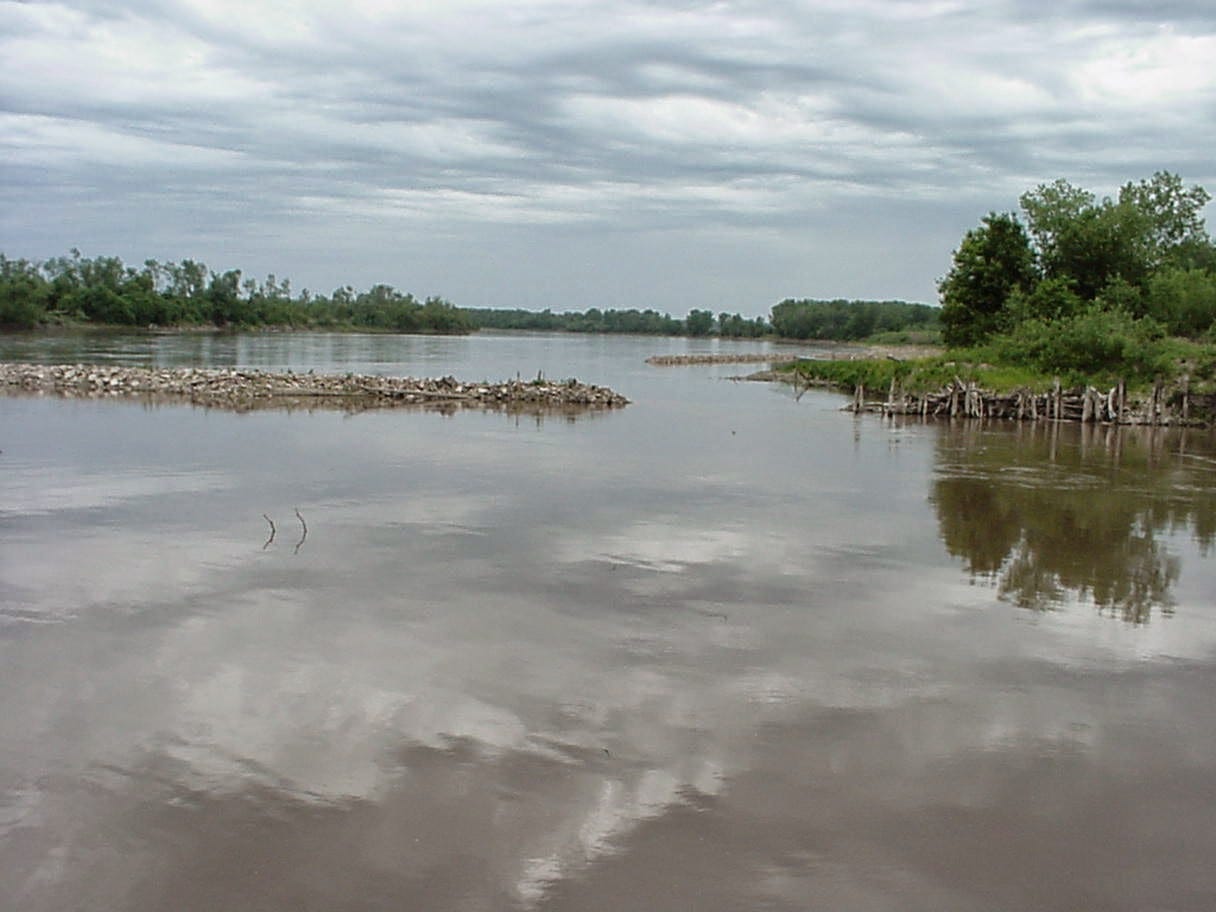
In fact, one major habitat, big river ecosystems, we destroyed for the express purpose of generating “clean” energy. The Missouri River, to cite one example, was turned from one of the longest and most varied fresh water habitats on the entire planet into a 600 mile long dredged, channelized, and managed ditch below six big hydroelectric dams.
Second, in spite of all the advertising and messaging, we cannot now and never could have built a clean energy industrial system which does not require fossil fuels. I understand that thousands of credentialed people have told you otherwise, have told you that “we have” the technology, but that is simply false. We don’t. As John Kerry said publicly just before COP 26,
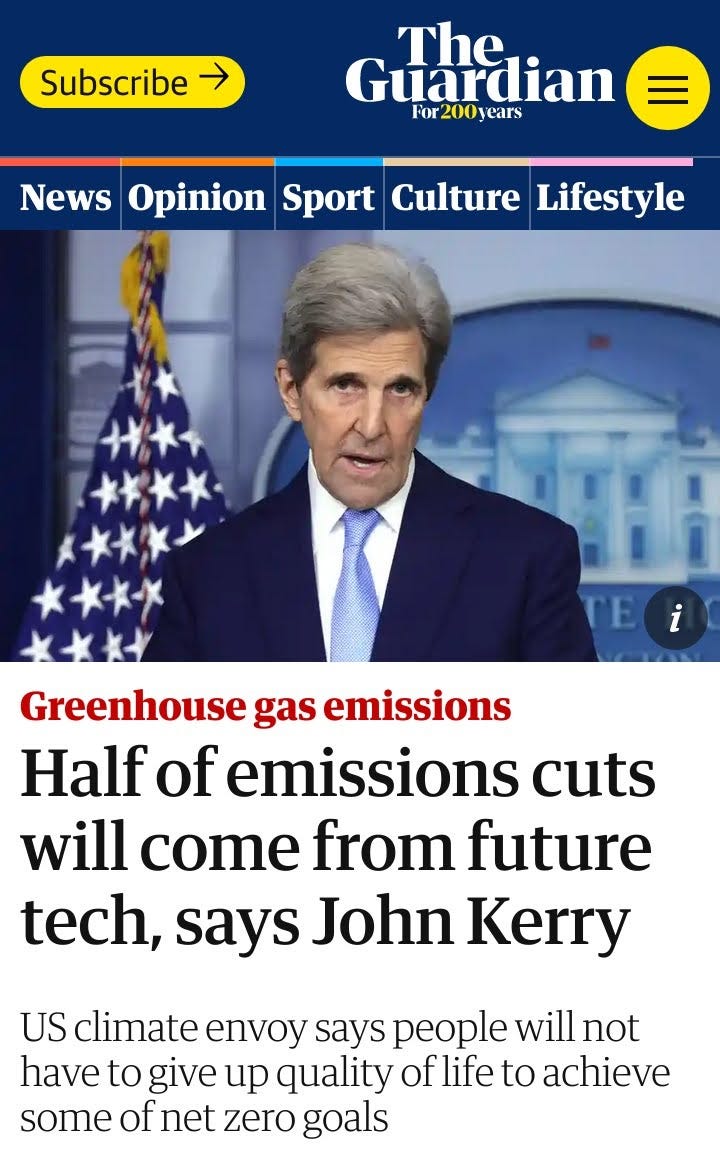
“You don’t have to give up a quality of life to achieve some of the things that we know we have to achieve. That’s the brilliance of some of the things that we know how to do,” he told BBC One’s Andrew Marr show. “I am told by scientists that 50% of the reductions we have to make to get to net zero are going to come from technologies that we don’t yet have. That’s just a reality.
Just as an aside, Kerry was savaged by the community of climate professionals for this statement. They were outraged by the very idea that he would admit in public that even if we had already built all the energy harvesting and storage machines that we are alleged to already have, we’d still fall fifty percent short of the emissions reductions we need.
But take comfort. As Mr. Kerry said, “…you don’t have to give up quality of life to achieve some of the things we know we have to achieve.”
Some of.
All we have to do is invent enough new technologies to decarbonize virtually all of mining, most of manufacturing, and all ocean and air transportation. Among other things.
Now, today, as modern technological societies attempt to make good on the falsehood of clean energy, our ecosystem degradation has accelerated to previously unimagined levels, and by our actions, not least the mining, smelting, transporting, transforming, hauling, and installation of our promised salvation in built technology, our emissions are higher than ever before. The rate of warming, rates of extinction, and literally every other measure of ecosystem collapse are also higher than ever before.
It wasn’t fossil fuel executives whose lies to us led to the current crisis. It was every voice which told us that we could keep our high speed, high energy, high tech, massively consumptive lifeways. It was John Kerry and Joe Biden. It was Elizabeth Warren and Michael Mann. Rachel Maddow’s in there somewhere. It was every registered participant of every COP meeting since COP1. It was the writers of the Paris Agreement.
Among those voices we can count almost the entire climate science community, every government on Earth, virtually all centers of higher learning, and, to be fair, just about everyone who lives in modern civilizations.
The grim truth is that before our massive degradation of the entire global ecosystem, land, water, and air, ends, we will have to either abandon, or simply lose access to, virtually every high speed, high energy, mass production, post-Industrial Revolution system we currently use. We will have to live mostly without concentrated energy.
Grim indeed. But better to face than to ignore.
This is why the broad insistence to blame the rich, or blame fossil fuel executives, or to blame any other nefarious actor for the mess we’re in, is both false and counterproductive.
Human societies can learn to live reasonably well, warm, comfortable, and well fed lives in small communities without cars, without televisions, without airplanes, without the internet, without personal computers, without most of what we think today is the bare minimum for life.
We don’t have to go back to caves. We don’t have to live in mud huts. We probably will have to return to horse, ox, or donkey drawn transportation, at least for heavy loads, and we will have to learn once again to walk, but none of these things will bring us misery.
We live in a society today where the biggest killers of people from young adulthood to early old age are deaths of depression, suicide, murder, and drugs, or deaths of toxic air, exhaust fumes, brake dust, and tire particles. We happily accept forty or fifty thousand deaths from automobile accidents a year, and ignore two to three hundred thousand people permanently maimed and crippled.
But ultimately none of that matters. Discussions of the relative pleasantness or unpleasantness of various technological parts of our lives are all based on the assumption that we have a choice whether to keep them or not.
We don’t.
When scientists and sciences tell us that we are approaching a tipping point, that our current way of life is not sustainable, they mean it. Earth and the laws of physics massively do not care if we’re happy about their workings. They simply work according to certain immutable laws or principles. “People don’t want to,” isn’t a factor.
I have written many essays on ways and means by which humans could begin a voluntary move away from high energy culture. The typical response has been “people won’t.” And I can’t dispute that. I can see.
All that means is that we won’t do it voluntarily. It specifically does not mean we won’t do it. We will.
It’s not the fossil fuel executives. It’s the system we have developed since the European conquest of the rest of the world.
There exist in the United States almost half a million people who live largely without the energies and systems the rest of us worldwide have used to destroy our ecosystem and our future. They live as they do by choice, a choice which their community does not empower them to make until they reach adulthood. They don’t think they’re miserable. There is no evidence anyone else would have to be to live in similar ways.
They chose to live as they do for religious reasons. I’m not a big fan of religion, but I do have to admit that the rest of us have never been able to figure out any other reason to live in any form of harmony with the world which evolved us. Even though ecological balance wasn’t the point of their decisions, it has been a beneficial unintended consequence.
Others of us could do it too. Just as the various religious old orders slowly expand, buy land, convert regions to horse and buggy, to horse farming, to hand powered tools, others of us could too. But first we’d have to quit blaming the fossil fuel industry. Electric cars are no better than gasoline cars, they’re just farther removed from the fossil fires that power them.
.
I'd have never used your name - you know why. Thanks for the, well, thanks for being you.
Really strong reframing here. The habitat destruction angle gets overlooked way too often in climate discussions. I've noticed this trend where ppl act like swaping to EVs or solar fixes everything while ignoring how much damage teh extraction and infrastructure itself causes. The point about hydroelectric dams destroying river ecosystems is a perfect example of how 'clean' energy isn't always clean for biodiversity.